Graph inference
How Nektar's ML models identify missing relationships, de-duplicate records, and connect activities to the right opportunities.
Nektar’s graph inference models identify relationships (“edges”) in the Nektar Graph that probably should exist, but don’t. This is basically our “one weird trick”: we found a way to reduce all your data problems into missing edges, so edge inference is (very nearly) all we need.
What it does
- de-duplication of contacts, leads, email messages and calendar events
- affinity AI, to identify relationships between data points (such as which opportunity an activity is related to.)
- edit protection: if a manual Salesforce edit reverts a change that Nektar made, remember the mistake to avoid making it again.
How it works
There are many different kinds of edges, so there are many different edge inference models. The ones we get asked about the most are about the “Activity-Opportunity”, “Person-Opportunity” and “Person-Account” pairs. They all follow a common approach:
-
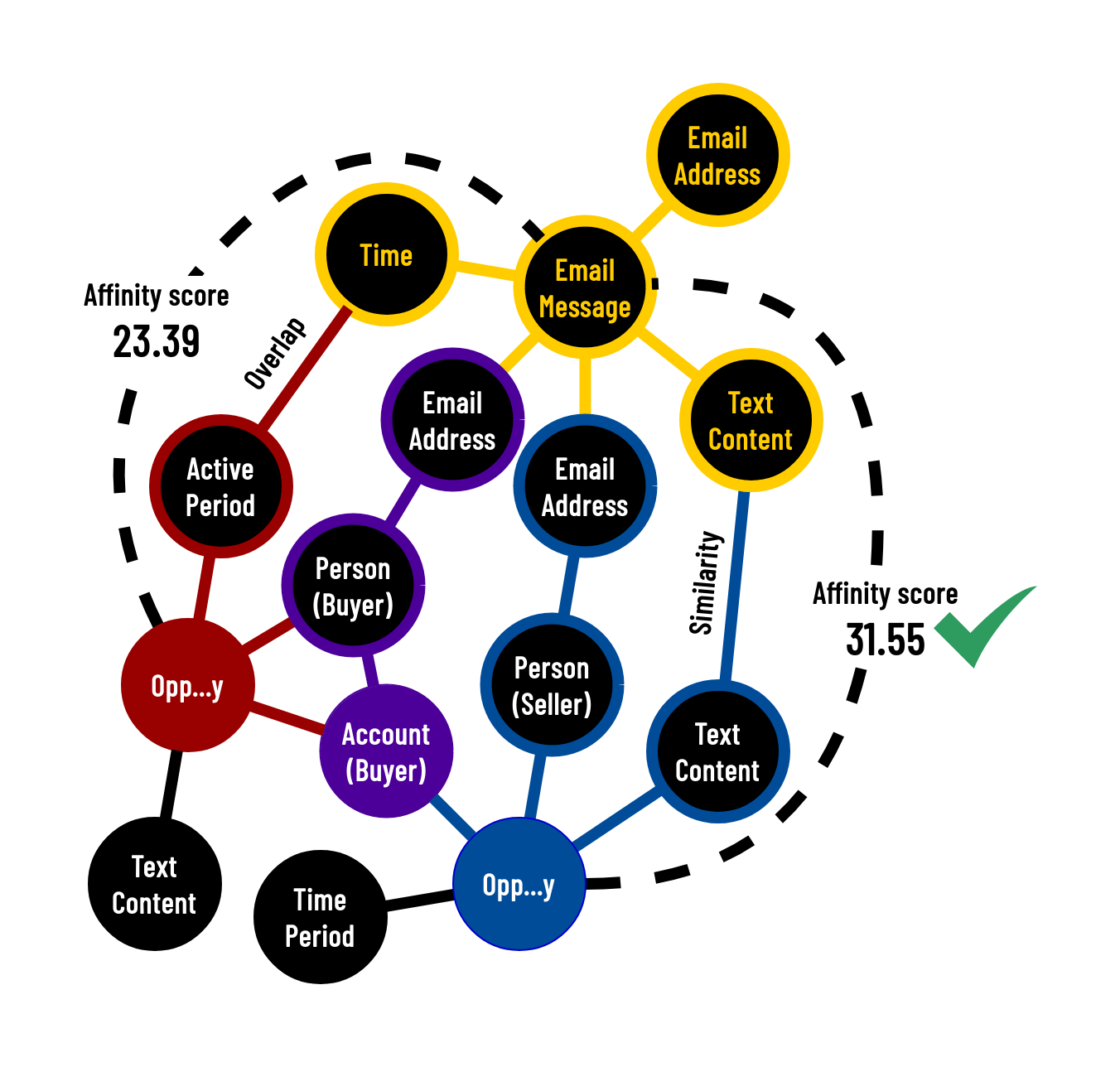
First, Nektar identifies candidate object pairs that might have an edge between them, but do not at present. It does this by exploring the neighborhood of each object by “hopping” along existing edges. Depending on the model, it may search up to 3 or 4 hops away from each object.
-
Nektar then uses a model to get the likelihood of each candidate edge. Inputs to this model include features of the objects themselves (such as timestamps and common text keywords), the number of paths between them, and the number and type of the objects and edges along those paths.
-
Based on the specific edge type, it creates edges: either for all candidates where the likelihood exceeds a threshold or only for the highest likelihood candidates.
Why it works
We mentioned how nearly all your data problems are modeled as missing edges. Here’s a couple of examples:
- Duplicate records are just missing “is the same as” relations between the pairs of records.
- Missing contacts are just missing “belongs to” relations between Salesforce accounts and opportunities and people your sellers are in touch with.
Nektar comes with edge inference models to solve a whole host of other data issues.